Evolution of Digital Technology: History & Trends (2026)
 Mian Bilal Ch
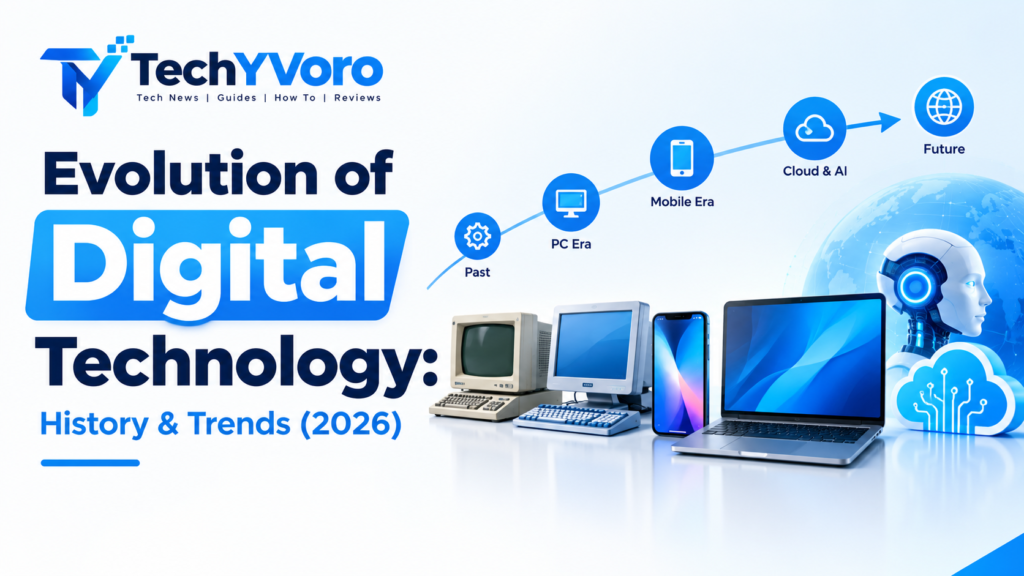
Digital technology has evolved from early electronic computers and basic data processing systems into a connected world powered by the internet, smartphones, cloud computing, and artificial intelligence. These developments have transformed how people communicate, learn, work, shop, and access information. In 2026, AI-powered applications, intelligent automation, advanced computing infrastructure, and connected devices continue to influence the direction of technological innovation.
Understanding the evolution of digital technology helps explain not only how modern devices work but also why digital services have become central to everyday life. This guide explores the major historical milestones, technologies shaping the digital world, practical benefits, potential risks, and developments that may influence the years ahead.
What Is the Evolution of Digital Technology?
The evolution of digital technology is the gradual development of electronic systems used to process, store, transmit, and analyze digital information. It includes the transition from early computers to personal computing, internet-connected devices, cloud platforms, mobile applications, and modern AI systems.
This evolution has made computing more accessible, communication faster, and digital services more widely available. It has also introduced challenges involving privacy, cybersecurity, digital access, and responsible technology use.
For example, a task that once required a physical visit, paper documents, and manual processing may now be completed through an online service. This change reflects the combined progress of computing hardware, networking, software, and digital infrastructure.
For more details, read our complete guide to information about Foxtpax software, including its claimed features, safety, and legitimacy.
A Timeline of Digital Technology Evolution
Digital technology did not develop through one invention alone. It advanced through several connected milestones, with each generation building on earlier discoveries and engineering improvements.
| Period | Major development | Why it mattered |
|---|---|---|
| 1940s–1950s | Early electronic computers | Enabled increasingly complex electronic calculations and data processing |
| 1960s–1970s | Integrated circuits and advances in computer networking | Helped improve computing capabilities and supported communication between systems |
| 1970s–1980s | Microprocessors and personal computers | Made computing more practical for businesses, institutions, and individuals |
| 1980s–1990s | Graphical interfaces and wider internet adoption | Made computers easier to use and expanded digital communication |
| 1990s–2000s | World Wide Web and online services | Changed how people found information, communicated, and conducted business |
| 2000s–2010s | Smartphones, broadband, and cloud services | Made digital tools more portable and accessible across locations |
| 2010s–2020s | Big data, IoT, machine learning, and automation | Expanded connected systems and data-driven applications |
| 2020s onward | Generative AI, AI agents, advanced robotics, and intelligent systems | Expanded the range of tasks that software can assist with or automate |
These periods overlap, and adoption varied across countries, industries, and communities. A technology’s invention date is also different from the date it became widely available.
Early Electronic Computing
Early electronic computers were developed to perform calculations and process information that would have been difficult or time-consuming to handle manually. Many were large, expensive systems used by research institutions, governments, and major organizations.
Over time, improvements in electronic components, memory, programming, and computer architecture made digital systems more capable. The development of transistors and integrated circuits was particularly important because it helped make electronic equipment smaller and more practical.
The Computer History Museum’s computer timeline documents important milestones in this development.
The Rise of Personal Computers
Personal computers expanded access to digital technology beyond specialized computing facilities. Businesses could use software for accounting, document preparation, record management, and communication, while individuals gained access to educational and creative applications.
Graphical user interfaces, keyboards, mice, and more accessible operating systems helped make computers easier to operate. Software ecosystems also grew, allowing users to perform an increasingly wide range of tasks on the same device.
This period established the personal computer as an important tool for education, administration, productivity, and entertainment.
The Internet and World Wide Web
The development of computer networks enabled systems in different locations to exchange information. The internet subsequently became a foundation for email, online publishing, digital communication, and many commercial services.
The World Wide Web made it easier to navigate linked documents and websites using web browsers. Search engines, online marketplaces, digital publishing, and web-based applications expanded the practical value of internet access.
Today, the internet supports activities ranging from remote learning and video calls to online banking and software delivery. Its growth has also increased the importance of protecting personal information and securing connected systems.
Smartphones and Cloud Computing
Smartphones combined mobile communication with internet access, cameras, navigation, applications, and other computing capabilities. As mobile networks and devices improved, people gained more ways to access digital services without needing a desktop computer.
Cloud computing changed how organizations and individuals access computing resources. Instead of relying exclusively on local hardware, users can access remotely hosted applications, storage, databases, and processing services through the internet.
Together, smartphones and cloud platforms helped make digital services more flexible and accessible. However, their usefulness depends on factors such as connectivity, service reliability, security, and cost.
The Shift Toward Intelligent Digital Systems
Machine learning, data analytics, and AI have expanded the ability of software to recognize patterns, generate content, make predictions, and assist with complex tasks.
Modern systems can combine cloud infrastructure, connected devices, data processing, and AI to support applications such as language translation, fraud detection, predictive maintenance, and digital assistants.
This does not mean that every AI output is accurate or that every task can be automated reliably. Human oversight, suitable data, testing, and clear limitations remain important.
Gaming enthusiasts can also read our article about why the Innerlifthunt game was postponed to learn more about the reported delay.
Why Has Digital Technology Evolved So Quickly?
Several developments have reinforced one another, helping digital technology advance and spread.
Improvements in Computing Hardware
More capable processors, memory systems, storage devices, and specialized chips have enabled increasingly demanding software. Hardware advances also support applications involving large datasets, graphics, scientific calculations, and AI.
Better Connectivity
Internet access, broadband, wireless networks, and mobile communications have made it easier to exchange information across distances. Better connectivity also supports services that depend on frequent communication between devices and remote systems.
Growth in Data Availability
Digital transactions, connected devices, online services, and sensors generate information that organizations can analyze. When collected and used appropriately, this data can help identify patterns and improve decisions.
However, more data does not automatically mean better decisions. Data quality, privacy, relevance, and context all matter.
Software Innovation and Automation
Software allows hardware to perform many different tasks without requiring a new physical device for each one. Cloud platforms, APIs, open-source tools, and reusable software components can also help developers build applications more efficiently.
Automation extends these capabilities by allowing software or machines to carry out defined tasks with reduced manual intervention.
Changing User Needs
People and organizations increasingly expect convenient communication, accessible services, rapid information retrieval, and flexible ways to work. These needs encourage the development of new tools, while competition and research contribute to further innovation.
Major Technologies Shaping the Digital World in 2026
Digital technology in 2026 includes both widely adopted systems and newer technologies whose long-term effects are still developing. The following areas illustrate the main directions of change.
1. Artificial Intelligence and Machine Learning
Artificial intelligence refers to technologies designed to perform tasks associated with capabilities such as language understanding, pattern recognition, planning, and content generation. Machine learning is a branch of AI that uses data to learn patterns or relationships.
AI is used in applications such as spam filtering, translation, recommendation systems, image recognition, coding assistance, and customer support.
Generative AI can produce text, images, audio, and other content in response to prompts. AI agents may also be designed to carry out sequences of tasks using tools, subject to their permissions and limitations.
Practical example: A business may use an AI assistant to draft routine communications, summarize documents, or help employees find information. Important outputs still require review, particularly when accuracy, confidentiality, or consequential decisions are involved.
AI can improve productivity in suitable situations, but it can also generate incorrect information, reproduce biases, or expose sensitive data if systems are used carelessly.
2. Cloud Computing and Edge Computing
Cloud computing provides computing resources, applications, and storage through network-accessible infrastructure. It can help organizations scale services without managing every underlying server themselves.
Edge computing processes some information closer to the devices or locations where the data is generated. This can reduce the need to send every piece of data to a distant server and may support applications that require timely responses.
| Feature | Cloud computing | Edge computing |
|---|---|---|
| Processing location | Remote data centers or hosted infrastructure | Near the data source or device |
| Common benefit | Flexible resources and centralized management | Potentially lower communication delay |
| Example | Hosting a website or online document service | Processing sensor readings on a local industrial system |
| Main consideration | Connectivity, cost, privacy, and service dependence | Device capacity, maintenance, and distributed security |
These approaches can work together. The best choice depends on the application’s performance requirements, available infrastructure, security needs, and operating costs.
For readers interested in troubleshooting technical problems, check out our guide on how to fix HSSGamepad connection issues for practical troubleshooting information.
3. Internet of Things and Smart Devices
The Internet of Things (IoT) refers to physical devices equipped with sensors, software, and connectivity that allow them to collect or exchange information.
Examples include smart thermostats, connected industrial equipment, environmental sensors, and certain healthcare monitoring devices.
IoT systems can help people monitor conditions remotely, automate routine operations, and identify equipment problems. They also create security challenges because connected devices may collect sensitive information or remain in service without adequate updates.
Organizations should consider device authentication, secure configuration, software updates, access controls, and data minimization when deploying connected systems.
4. Big Data Analytics and Automation
Big data analytics involves examining large or complex datasets to identify patterns, trends, and useful relationships. Organizations may use these techniques to understand customer needs, monitor operations, or estimate demand.
Automation allows repetitive or rule-based tasks to be performed by software or machinery. When combined with analytics, automation can support inventory monitoring, document processing, quality checks, and predictive maintenance.
The benefits depend on how well a system is designed. Poor data, unclear rules, and insufficient oversight can lead to errors at scale.
5. Cybersecurity and Digital Trust
As more activities depend on connected technology, protecting devices, accounts, networks, and information becomes increasingly important.
Cybersecurity includes practices and technologies such as multifactor authentication, encryption, access control, security monitoring, backups, and software updates.
AI can assist with identifying suspicious activity and prioritizing security alerts. However, AI is not a complete security solution, and attackers can also use automated tools.
Individuals and organizations should combine appropriate technology with sound security practices, staff awareness, incident planning, and regular review.
6. Emerging Developments: AI Agents and Robotics
AI agents are systems designed to pursue defined objectives by carrying out multiple steps, potentially using software tools or external services. Robotics combines physical machines with sensing, control, and software to perform tasks in the real world.
Potential applications include warehouse operations, manufacturing, scientific research, software development, and assistance with complex workflows.
These technologies are not equally mature across all applications. Reliability, operating costs, safety, data access, and human supervision can determine whether a deployment is practical.
McKinsey’s Technology Trends Outlook 2026 discusses developments across AI infrastructure, agentic systems, robotics, cybersecurity, and other technology domains. Such reports are useful for understanding current industry priorities, but they should not be treated as guarantees of future adoption.
If you are exploring more technology topics, our Windstrebe guide provides additional information about a different tech-related subject.
How Digital Technology Has Changed Everyday Life
The evolution of digital technology affects people in many ways, from routine personal tasks to essential public services.
Communication
Messaging applications, video calls, email, and online communities allow people to communicate across distances. These tools can support personal relationships, remote collaboration, and access to information.
At the same time, misinformation, online harassment, and excessive notifications can reduce the quality of digital communication.
Education
Online learning platforms, digital libraries, educational videos, and interactive tools can make learning resources more accessible. AI-based tools can also help explain concepts or provide practice exercises.
Their effectiveness depends on content quality, reliable internet access, accessibility, and the learner’s ability to evaluate information critically.
Healthcare
Digital records, telehealth services, medical imaging systems, and connected monitoring devices can support healthcare delivery and communication between patients and professionals.
These systems must be designed with privacy, reliability, safety, and appropriate clinical oversight in mind. Not every service is suitable for remote delivery, and technology does not replace professional medical judgment.
Business and Work
Organizations use digital systems for collaboration, customer service, accounting, inventory management, data analysis, and many other operations.
Cloud platforms can support distributed teams, while automation can reduce repetitive work. However, organizations must consider employee training, system integration, data protection, and the possibility of errors.
Shopping, Banking, and Entertainment
E-commerce platforms, digital payments, streaming services, and online marketplaces have changed how people buy products and access entertainment.
These services can be convenient, but users should remain aware of scams, fraudulent websites, account security, privacy policies, and the reliability of online sellers.
Benefits and Challenges of Modern Digital Technology
Digital technology can create substantial benefits, but its effects depend on how systems are designed, deployed, and used.
Key Benefits
- Greater efficiency: Software and automation can reduce repetitive manual tasks.
- Faster communication: Connected systems allow information to move quickly between people and organizations.
- Broader access to information: Digital resources can support education, research, and problem-solving.
- Improved analysis: Data tools can help organizations identify patterns and make better-informed decisions.
- Flexible services: Online platforms can make certain services accessible across different locations and schedules.
- New capabilities: AI and connected devices can support tasks that were previously difficult or expensive to perform.
Important Challenges
- Privacy risks: Digital systems may collect more personal information than users expect.
- Cybersecurity threats: Weak passwords, unpatched software, and social engineering can expose accounts and systems.
- Digital inequality: Access to reliable connectivity, devices, and digital skills remains uneven.
- Skills gaps: New tools may require training and changes to established workflows.
- Misinformation: Generated or manipulated content can make it harder to assess the reliability of information.
- Environmental costs: Computing infrastructure requires electricity, equipment, and physical resources.
- Reliability concerns: Software failures, outages, and inaccurate automated outputs can disrupt important activities.
How to Use Digital Technology More Responsibly
Individuals should use strong, unique passwords, enable multifactor authentication where available, install updates, and review application permissions. Sensitive information should be shared only with services that have an appropriate purpose and trustworthy safeguards.
Organizations should define clear objectives before adopting new systems, assess privacy and security risks, train users, test important workflows, and maintain human oversight for consequential decisions.
The goal should not be to adopt every new technology. It should be to choose tools that solve real problems and manage their limitations responsibly.
Traditional vs. Modern Digital Technology
Modern systems often provide greater connectivity, portability, and automation than older systems, although traditional methods can remain useful where simplicity, reliability, or independence from network access is important.
| Area | Traditional approach | Modern digital approach |
|---|---|---|
| Information storage | Paper records and local physical media | Digital files, databases, and cloud storage |
| Communication | Letters, landline calls, and in-person meetings | Email, messaging, video calls, and collaboration platforms |
| Information access | Printed materials and physical archives | Search engines, digital libraries, and online databases |
| Business processes | Manual forms and repetitive data entry | Software workflows and selected automated tasks |
| Computing access | Dedicated computers and local installations | Personal devices, hosted services, and cloud applications |
| Data analysis | Manual calculations and basic reporting | Advanced analytics and machine-learning tools |
This comparison is not absolute. Modern systems can still depend on local equipment, while older approaches may be more appropriate in some settings. Technology choices should reflect the actual task, available resources, accessibility needs, and risks.
What Is the Future of Digital Technology?
The future of digital technology will depend on technical progress, economic conditions, regulation, user needs, and how effectively emerging systems address their limitations.
Several developments are worth watching.
More Capable AI Systems
AI tools may become more integrated into software, research, customer service, and everyday workflows. AI agents may handle increasingly complex sequences of tasks in suitable environments.
Progress will depend on reliability, cost, evaluation, security, and the ability to keep people appropriately involved.
Robotics and Intelligent Automation
Robotics may expand in manufacturing, logistics, agriculture, and other settings where physical tasks can be performed safely and economically. Adoption will vary because real-world environments are often less predictable than controlled demonstrations.
Advances in Computing Infrastructure
Specialized processors, improved data-center systems, and new approaches to computing may support increasingly demanding applications. Energy use, cooling, supply chains, and infrastructure costs will remain important considerations.
Connected Systems and Edge Processing
Connected devices and local processing may help support applications that need timely responses or operate in environments with limited connectivity. Their usefulness will depend on secure implementation, device maintenance, and suitable network infrastructure.
Responsible AI and Cybersecurity
As digital systems become more capable, organizations will need to pay greater attention to accountability, privacy, secure development, transparency, and risk management.
The NIST AI Risk Management Framework provides guidance for considering trustworthiness and risk when developing or using AI systems.
These developments represent possible directions, not certain outcomes. Some technologies may mature quickly, while others may face technical, financial, regulatory, or practical barriers.
Frequently Asked Questions
What is the evolution of digital technology?
The evolution of digital technology is the progression from early electronic computing and basic digital communication to personal computers, internet-connected devices, cloud platforms, AI, and intelligent automated systems. Each stage has expanded how people process, store, share, and use information.
What are the major stages in digital technology history?
Major stages include early electronic computing, the development of transistors and integrated circuits, personal computers, computer networking, the internet and World Wide Web, smartphones, cloud computing, connected devices, and modern AI systems. These developments overlapped and spread at different rates.
How has AI changed digital technology?
AI has enabled software to recognize patterns, generate content, assist with coding, analyze information, and support selected automated workflows. Its usefulness depends on the task, quality of the system, available data, and appropriate human review.
What are the benefits and risks of digital technology?
Benefits include faster communication, access to information, more efficient workflows, and improved data analysis. Risks include privacy violations, cyberattacks, misinformation, unequal access, environmental costs, and overreliance on unreliable systems.
What technologies may shape the next decade?
AI, robotics, advanced computing infrastructure, connected devices, cybersecurity, and emerging scientific technologies may influence the next decade. The speed and extent of adoption remain uncertain and will vary across applications and industries.
Conclusion
The evolution of digital technology reflects decades of progress in computing, communication, software, and connected systems. From early electronic computers to smartphones, cloud platforms, and AI, each stage has expanded the ways people access information and solve problems.
In 2026, the most important question is not simply which technology is newest. It is how effectively, securely, and responsibly that technology addresses real needs. Understanding both the benefits and limitations of digital systems helps individuals and organizations make better decisions as technology continues to develop.
For further reading, explore TechyVoro’s guide to AI-powered digital transformation and its coverage of emerging software and technology developments.


2 Comments