How to Create a Social Media Strategy in 2026 (Step-by-Step)
 Mian Bilal Ch
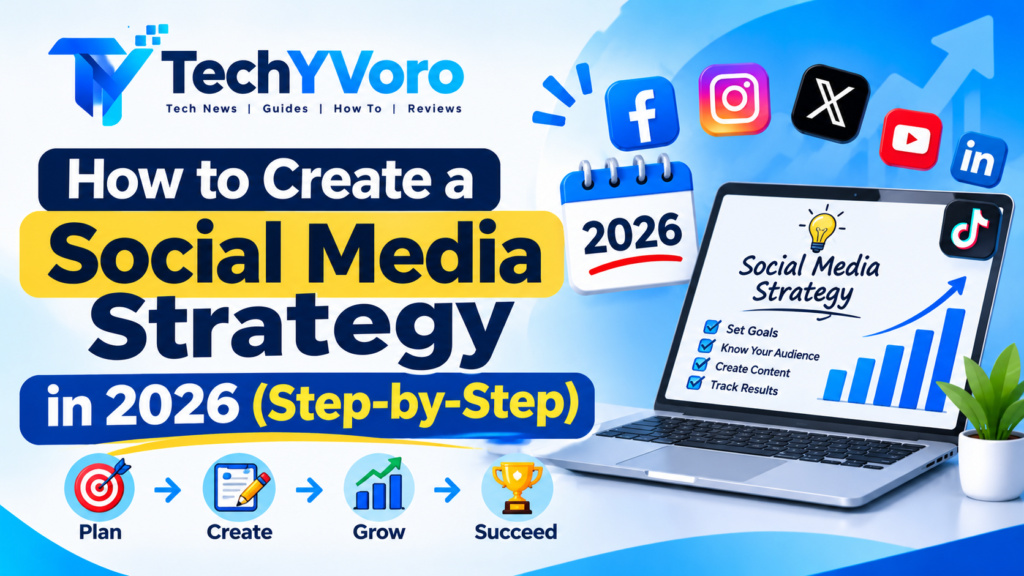
Social media can help businesses build brand awareness, connect with customers, generate website traffic, and increase sales. However, publishing posts without clear goals or understanding your audience rarely creates a consistent marketing process. A successful approach requires planning, relevant content, platform selection, and regular performance measurement.
Learning how to create a social media strategy starts with understanding what your business wants to achieve and which audiences you need to reach. You then select suitable platforms, develop content pillars, create a publishing calendar, and measure meaningful results.
This guide explains how to build a practical social media marketing strategy in 2026, including platform comparisons, content planning examples, important KPIs, and a manageable 30-day implementation plan.
Quick Answer: How Do You Create a Social Media Strategy?
To create a social media strategy, follow these eight steps:
- Define your business goals and marketing objectives.
- Research your target audience and understand their interests.
- Audit your existing social media accounts and content.
- Analyze competitors to identify opportunities.
- Choose platforms that match your audience and business.
- Develop content pillars and a consistent content strategy.
- Create a social media content calendar and posting schedule.
- Engage with your audience, measure performance, and improve your approach.
The most important principle is to connect every social media activity to a specific business objective. A strategy designed to generate leads will require different content and KPIs from one focused on brand awareness or community building.
Retail business owners can also explore Best Apps for Retailers to discover useful apps for managing sales, inventory, customer relationships, and everyday store operations.
What Is a Social Media Strategy?
A social media strategy is a documented approach that explains how a business will use social media platforms to achieve its marketing objectives. It identifies the target audience, selected platforms, content direction, publishing responsibilities, engagement activities, and performance measurements.
Rather than posting whenever new ideas appear, businesses use a social media strategy to make their activities more consistent and purposeful.
A practical strategy usually includes:
- Business goals: What the company wants to accomplish.
- Target audience: The people it wants to reach.
- Platform selection: The social networks that fit its audience and resources.
- Content strategy: The topics, formats, and messages it will publish.
- Publishing schedule: When and how frequently content will appear.
- Engagement approach: How the business will communicate with its audience.
- Performance measurement: The KPIs used to evaluate results.
- Optimization: How the strategy will change based on performance.
For example, a small online clothing store might use Instagram to showcase products, Facebook to communicate with local customers, and short-form videos to demonstrate product details.
The objective is not to maintain an account on every platform. It is to select the channels that provide the most relevant opportunities.
Social Media Strategy vs. Social Media Plan
Although these terms are often used together, they describe different parts of the marketing process.
| Social media strategy | Social media plan |
|---|---|
| Defines the overall direction | Explains how activities will be completed |
| Establishes business objectives | Organizes individual marketing tasks |
| Identifies target audiences | Assigns content and publishing responsibilities |
| Determines suitable platforms | Sets publishing dates and schedules |
| Defines success measurements | Tracks execution and progress |
Think of the strategy as the overall direction and the plan as the practical schedule used to execute it.
For instance, a business strategy might focus on generating qualified leads through LinkedIn. Its social media plan would specify the weekly educational posts, publishing dates, responsible team members, and lead-generation calls to action.
How to Create a Social Media Strategy in 8 Steps
Building an effective social media strategy does not require a complicated marketing department. Small businesses and beginners can start with a clear objective, a few suitable platforms, and a realistic publishing schedule.
Step 1. Define Your Business Goals
Start by identifying what you expect social media to accomplish.
Without clear objectives, it becomes difficult to determine which activities deserve your time and marketing budget.
Common social media marketing goals include:
- Increasing brand awareness.
- Generating website traffic.
- Finding potential customers.
- Increasing product or service sales.
- Building an active community.
- Improving customer communication.
- Supporting customer retention.
Choose one primary objective and a small number of supporting goals.
For example, an online software company might want to increase qualified website visits and encourage more visitors to request product demonstrations.
Your objective should be specific enough to measure.
Example of a SMART social media objective:
“Increase qualified website visits from LinkedIn by 15% over the next 90 days compared with the previous 90-day period.”
This objective identifies the intended result, platform, measurement, and timeframe. The 15% figure is an illustrative target, not a universal benchmark.
Avoid setting goals based only on follower growth. A business may gain followers without attracting people who are interested in its products or services.
Step 2. Research Your Target Audience
Your social media strategy should be built around the people you want to reach.
Researching your audience helps you understand what they need, which platforms they use, what problems they experience, and which types of content they find useful.
Consider these audience characteristics:
| Audience factor | Questions to investigate |
|---|---|
| Age and location | Which age groups and regions are relevant? |
| Interests | What subjects attract their attention? |
| Challenges | Which problems are they trying to solve? |
| Online behavior | Where do they discover information? |
| Buying behavior | What influences their purchasing decisions? |
| Content preferences | Do they prefer videos, articles, images, or discussions? |
You can gather useful information through:
- Customer interviews and surveys.
- Website analytics.
- Social media account insights.
- Customer support questions.
- Relevant online communities.
- Competitor audience discussions.
- Search trends and industry research.
For example, a business selling professional software may discover that its potential customers want tutorials, product comparisons, workflow demonstrations, and practical solutions to technical problems.
That information can guide its content strategy.
Create a simple audience persona
An audience persona is a fictional representation of a relevant customer group based on research.
Example:
| Attribute | Example persona |
|---|---|
| Profile | Small business owner |
| Main challenge | Limited marketing resources |
| Primary interest | Affordable customer acquisition |
| Preferred content | Tutorials and practical examples |
| Possible platforms | Facebook, Instagram, YouTube |
| Main motivation | Generate more qualified inquiries |
Do not treat a persona as a verified description of every customer. Use it as a planning tool and update it when better information becomes available.
Readers interested in the latest software developments can also explore AlienSync Updates 2026 to learn about its reported updates, new features, and important developments.
Step 3. Audit Your Existing Social Media Accounts
If your business already uses social media, review its existing presence before creating new accounts or publishing more content.
A social media audit identifies what is working, what needs improvement, and where opportunities may exist.
Review the following:
- Profile names, descriptions, and branding.
- Website links and contact information.
- Content formats and publishing frequency.
- Audience growth and engagement.
- Posts that receive meaningful interactions.
- Website visits and referral traffic.
- Leads, inquiries, and conversions where measurable.
Use this checklist:
- Are all business profiles complete?
- Is the branding consistent?
- Does every profile explain what the business offers?
- Are website and contact links correct?
- Which content formats receive useful engagement?
- Are customer comments and messages being answered?
- Can social media traffic be measured?
- Are inactive or unnecessary accounts still being maintained?
For Facebook and Instagram, Meta Business Suite provides insights into content performance, interactions, views, and follows, depending on account setup and available features.
You can explore its Meta Business Suite insights guidance.
The purpose of an audit is not simply to find weaknesses. It is to understand which activities deserve more attention and which ones should be reconsidered.
Step 4. Analyze Your Competitors
Competitor analysis helps you understand how similar businesses communicate with their audiences.
Select a few relevant competitors and examine their public social media activity.
Look for:
- Main content topics.
- Frequently used content formats.
- Audience questions.
- Engagement patterns.
- Brand positioning.
- Promotional messages.
- Customer feedback.
- Topics that receive little useful coverage.
Create a simple comparison:
| Research area | Questions |
|---|---|
| Content | What subjects do competitors publish about? |
| Formats | Do they use videos, carousels, articles, or images? |
| Audience | Who appears to interact with their content? |
| Engagement | Which posts generate discussions or shares? |
| Positioning | What makes their messaging different? |
| Content gaps | Which customer questions remain unanswered? |
For example, if several competitors publish product advertisements but provide few educational demonstrations, your business could create useful tutorials that explain how products solve real customer problems.
However, competitor research should inspire original ideas rather than encourage copying.
Your objective is to understand the market and identify a distinct way to provide value.
Step 5. Choose the Right Social Media Platforms
Selecting suitable platforms is one of the most important parts of building a social media marketing strategy.
Every platform has different content formats, communities, audience characteristics, and business applications.
Maintaining too many accounts can also divide your time and resources.
Consider these major platforms:
| Platform | Potential business uses | Common content formats |
|---|---|---|
| Visual branding, products, community engagement | Reels, Stories, carousels | |
| Local businesses, groups, customer communication | Posts, videos, groups | |
| TikTok | Short-form discovery and product demonstrations | Short videos |
| B2B marketing and professional services | Articles, documents, posts | |
| YouTube | Education, tutorials, product demonstrations | Shorts, long-form videos |
| Visual discovery and inspiration | Pins and collections | |
| Niche communities and relevant discussions | Community discussions |
How should you select a platform?
Ask five questions:
- Does your target audience actively use this platform?
- Does its content format match your products or services?
- Can your team consistently create suitable content?
- Does the platform support your marketing objective?
- Can you measure the results that matter?
For example:
- A clothing brand may prioritize Instagram and Pinterest.
- A professional consulting business may focus on LinkedIn.
- A software company may benefit from YouTube tutorials and LinkedIn discussions.
- A neighborhood restaurant may use Facebook and Instagram for local communication and visual content.
These are starting points, not fixed rules.
Audience behavior differs by country, industry, age group, and customer segment. For example, Pew Research Center’s 2026 U.S. social media fact sheet reports that YouTube and Facebook are widely used among U.S. adults. Its figures describe U.S. respondents and should not be treated as global platform usage statistics.
Start with one or two platforms that offer a strong audience fit. Expand only when your business can maintain a consistent presence.
Step 6. Develop Your Social Media Content Strategy
Once you understand your audience and platforms, decide what your business should publish.
A social media content strategy establishes the topics, messages, formats, and objectives behind your posts.
One useful approach is to create content pillars.
Readers interested in web development can also explore Best Frontend Frameworks 2026 to compare popular frameworks, understand their features, and choose the right option for modern web projects.
What are content pillars?
Content pillars are recurring subject areas that organize your publishing activities around audience interests and business objectives.
A business might use these five content pillars:
| Content pillar | Purpose | Example |
|---|---|---|
| Educational | Help audiences understand useful topics | Tutorials and tips |
| Promotional | Explain products and services | Product demonstrations |
| Community | Encourage conversations | Questions and discussions |
| Trust-building | Establish credibility | Customer feedback and process explanations |
| Entertainment | Make content more engaging | Relevant humor and storytelling |
The proportion of each content type should depend on your business and audience. There is no universal ratio that every company must follow.
Create content for different customer journey stages
People may encounter your brand at different stages of their buying journey.
| Customer journey | Content ideas | Objective |
|---|---|---|
| Awareness | Tips, short videos, educational posts | Introduce the brand |
| Consideration | Comparisons, tutorials, product explanations | Help people evaluate options |
| Decision | Demonstrations, testimonials, FAQs | Support purchasing decisions |
| Retention | Updates, guides, customer support | Maintain relationships |
For example, a software company could publish a beginner tutorial to attract new audiences, a comparison post to help potential customers evaluate solutions, and a product demonstration to explain its features.
Create content that answers real questions
Customer questions are valuable sources of content ideas.
If customers regularly ask about pricing, setup, compatibility, product benefits, or common problems, turn those questions into educational posts.
You can also use AI tools to brainstorm content ideas, organize calendars, and prepare caption drafts.
For additional AI software discovery, see TechyVoro’s guide to Goseboze AI tools.
However, review AI-generated material before publishing. Verify facts, respect customer privacy, check image and content rights, and ensure that the final message reflects your brand’s voice.
Step 7. Create a Social Media Content Calendar
A social media content calendar organizes what you plan to publish, where you will publish it, and when it should appear.
It makes content planning easier and reduces the pressure of creating new ideas at the last minute.
A useful calendar includes:
- Publishing date.
- Social media platform.
- Content topic.
- Content format.
- Marketing objective.
- Caption or creative status.
- Call to action.
- Responsible team member.
- Performance KPI.
Example: One-week social media content calendar
| Day | Platform | Content idea | Objective |
|---|---|---|---|
| Monday | Industry tips | Awareness | |
| Tuesday | Product demonstration | Engagement | |
| Wednesday | Customer question | Community | |
| Thursday | YouTube | Educational tutorial | Traffic |
| Friday | Product benefits | Conversion |
This is an illustrative schedule. A business does not need to publish on every listed day or use every platform.
How often should businesses post on social media?
There is no single posting frequency that works for every business.
Your publishing schedule should reflect:
- Available production resources.
- Audience activity.
- Platform-specific insights.
- Content quality.
- Business objectives.
- Historical performance.
A smaller business may benefit more from a manageable schedule of several useful posts each week than from daily posts that offer little value.
Review your account analytics to identify when your audience is active and which publishing patterns are sustainable.
Use content repurposing carefully
One useful idea can become several different content formats.
For example, a detailed blog post could be repurposed into:
- An Instagram carousel.
- A short educational video.
- A LinkedIn discussion.
- A YouTube tutorial.
- A Pinterest graphic.
Adapt the message to each platform instead of copying and pasting identical material everywhere.
Step 8. Build an Engagement and Measurement System
Publishing content is only one part of social media marketing.
Businesses also need to communicate with their audiences and evaluate whether their activities support the intended objectives.
An engagement strategy should explain how your business will:
- Respond to comments.
- Answer direct messages.
- Address customer concerns.
- Participate in relevant discussions.
- Encourage useful conversations.
- Monitor brand mentions.
- Handle complaints professionally.
For example, an online retailer could respond to questions about product availability, delivery, and returns through its social media accounts.
A software company might use comments and community discussions to identify recurring technical questions and develop helpful tutorials.
Create a simple engagement workflow
- Check important notifications regularly.
- Prioritize customer questions and service issues.
- Respond with accurate and relevant information.
- Escalate sensitive complaints to the appropriate team.
- Record recurring questions and feedback.
- Use those insights to improve future content.
Community management should be treated as part of the marketing strategy rather than an optional activity.
How to Build an Effective Social Media Content Strategy
A content strategy becomes more useful when it connects audience needs, publishing formats, and business objectives.
Start by identifying three to five main content pillars. Then develop ideas under each pillar and choose formats that suit the platform.
For example, an e-commerce business selling skincare products might use:
| Content pillar | Example content |
|---|---|
| Education | Skincare routine explanations |
| Product information | Ingredient and product demonstrations |
| Customer questions | Answers to common skincare concerns |
| Brand trust | Verified customer feedback |
| Promotion | Product announcements and offers |
When discussing health-related or product-performance claims, businesses should use appropriate evidence and avoid unsupported promises.
A useful content strategy should also include an editorial review process.
Before publishing, check:
- Is the information accurate?
- Does the content address a real audience need?
- Is the message appropriate for the platform?
- Are images and other assets properly licensed?
- Is the call to action clear?
- Does the content support a defined objective?
These checks help maintain consistent quality as publishing activity increases.
How to Measure Social Media Strategy Performance
A social media strategy should be evaluated using metrics connected to its objectives.
The number of followers alone cannot show whether your marketing activities are generating meaningful business results.
Important Social Media KPIs
A Key Performance Indicator (KPI) is a measurable value used to evaluate progress toward a specific objective.
| Business objective | Useful KPI | What it indicates |
|---|---|---|
| Brand awareness | Reach | Unique accounts or people reached, as defined by the platform |
| Content exposure | Impressions or views | How often content is displayed or viewed |
| Engagement | Comments, shares, saves and interactions | Audience response |
| Website traffic | Link clicks and website sessions | Visits generated through social media |
| Lead generation | Qualified leads | Potential customers generated |
| Sales | Purchases and attributed revenue | Commercial outcomes |
| Community growth | Relevant follower growth | Development of the audience |
Metric definitions can differ between platforms. Always use the platform’s own documentation when comparing reports.
How to calculate engagement rate
A commonly used engagement-rate calculation is:
Engagement Rate = (Total Engagements ÷ Reach) × 100
For example, if a post receives 120 engagements and reaches 3,000 accounts:
Engagement Rate = (120 ÷ 3,000) × 100 = 4%
This is an illustrative calculation. Some platforms and reporting tools use followers, impressions, or other denominators, so state which formula you use when comparing results.
How to Measure Social Media ROI
Return on Investment (ROI) helps businesses evaluate whether their marketing expenditure produces sufficient financial value.
A simplified formula is:
ROI = ((Revenue − Marketing Cost) ÷ Marketing Cost) × 100
For example:
- Attributed campaign revenue: $5,000
- Marketing cost: $2,000
- Estimated ROI: 150%
This example assumes that the full $5,000 is attributable to the campaign and excludes any additional costs not included in the $2,000 figure.
Actual social media attribution can be more complicated. Customers may interact with multiple channels before purchasing, and not every sale can be directly attributed to a single post.
For better measurement, track relevant website actions, leads, and purchases instead of relying entirely on platform engagement metrics.
Readers interested in web development can also explore Best Frontend Frameworks 2026 to compare popular frameworks, understand their features, and choose the right option for modern web projects.
How to Track Website Traffic From Social Media
Google Analytics 4 can help businesses understand where website traffic originates.
UTM parameters are tags added to destination URLs to identify campaign sources and other details.
For example:
The main parameters include:
utm_source: Identifies the traffic source.utm_medium: Identifies the marketing medium.utm_campaign: Identifies the campaign.utm_content: Helps distinguish different creative links.
Use consistent lowercase naming conventions to avoid splitting campaign reports into different values.
Google explains how to create and measure these campaign URLs in its official GA4 campaign URL documentation.
Organic vs. Paid Social Media Strategy
Businesses can use organic social media, paid advertising, or a combination of both.
The right approach depends on marketing objectives, available resources, audience behavior, and the stage of the business.
| Organic social media | Paid social media |
|---|---|
| Uses unpaid publishing and engagement | Uses advertising budgets |
| Builds an ongoing brand presence | Supports targeted campaign distribution |
| Relies on content relevance and audience relationships | Uses available advertising targeting and campaign settings |
| Can support long-term community development | Can help test and promote specific offers |
| Does not require payment for every post | Requires advertising expenditure |
When should businesses prioritize organic social media?
Organic activity can be a sensible starting point when a business needs to:
- Establish its brand identity.
- Understand audience interests.
- Publish educational content.
- Build customer relationships.
- Develop a consistent publishing process.
When should businesses consider paid social media?
Paid campaigns may be appropriate when a business has:
- A clearly defined target audience.
- A relevant offer or landing page.
- A measurable campaign objective.
- Suitable creative assets.
- A budget it can afford to test.
- A process for measuring leads or conversions.
Paid advertising should not be treated as a substitute for a clear marketing strategy.
A Practical 30-Day Social Media Strategy Implementation Plan
A 30-day plan can help beginners organize their first month of social media marketing.
It is an implementation schedule, not a guarantee of audience growth or sales.
| Period | Activities | Expected output |
|---|---|---|
| Days 1–7 | Define goals, research audiences and audit accounts | Research and objectives |
| Days 8–14 | Analyze competitors, choose platforms and establish content pillars | Platform and content strategy |
| Days 15–21 | Create content, prepare captions and organize the calendar | Ready-to-publish content |
| Days 22–30 | Publish, engage, monitor KPIs and review initial results | Initial performance report |
Week 1: Research and objectives
Identify your business goals, target customers, audience problems, and existing social media performance.
Week 2: Strategy development
Choose the most relevant platforms, establish content pillars, and identify the types of posts your business should create.
Week 3: Content preparation
Prepare your first publishing calendar, write captions, create visuals, and assign responsibilities.
Week 4: Launch and evaluate
Start publishing, respond to audience interactions, and review early performance data.
At the end of the month, identify what should continue, what needs improvement, and which ideas deserve further testing.
Common Social Media Strategy Mistakes to Avoid
Even businesses with active social media accounts can struggle when their marketing activities lack direction.
Avoid these common mistakes:
1. Trying to Use Every Platform
Maintaining too many social media accounts can spread your resources too thin. Prioritize platforms where your target audience is relevant.
2. Posting Without a Clear Objective
Every post does not need to generate a sale, but your overall publishing strategy should have a defined purpose.
3. Ignoring Audience Research
Content based on assumptions may fail to address the questions and problems of potential customers.
4. Copying Competitors
Competitor research should help you understand market opportunities. Develop original content that reflects your own products, expertise, and audience.
5. Publishing Identical Content Everywhere
Different platforms have different formats and audience expectations. Adapt your message instead of automatically duplicating every post.
6. Focusing Only on Followers
Follower growth does not necessarily translate into website traffic, qualified leads, or sales. Track outcomes that matter to your business.
7. Ignoring Comments and Messages
Unanswered customer questions can create a poor communication experience. Establish a consistent response process.
8. Failing to Measure Conversions
Engagement is useful, but businesses should also understand whether social activity contributes to their commercial objectives.
9. Expecting Immediate Results
Building an audience and developing a consistent marketing process takes time. Review performance across suitable periods rather than judging the entire strategy from a few posts.
Frequently Asked Questions About Social Media Strategy
1. What is a social media strategy?
A social media strategy is a plan for using social media platforms to achieve business and marketing objectives. It defines the target audience, selected platforms, content direction, engagement activities, publishing schedule, and performance measurements.
2. How do beginners create a social media strategy?
Beginners should start by defining one main business objective, researching their target audience, selecting one or two suitable platforms, and developing a manageable content calendar. They should then publish useful content, engage with their audience, and review performance regularly.
3. What are the main components of a social media strategy?
The main components include business goals, audience research, competitor analysis, platform selection, content pillars, publishing schedules, community management, KPIs, and performance optimization.
4. Which social media platform is best for small businesses?
There is no universally best platform. Instagram may suit visual products, Facebook may support local communities, LinkedIn can help B2B businesses, and YouTube may be useful for tutorials and product demonstrations. The right choice depends on the target audience and business objectives.
5. How often should a business post on social media?
Posting frequency depends on the platform, audience behavior, content quality, and available resources. Businesses should choose a sustainable schedule and use their account insights to evaluate whether their publishing frequency is appropriate.
6. How long does it take for a social media strategy to work?
There is no guaranteed timeframe. Initial engagement patterns may become visible relatively quickly, but building a relevant audience, generating qualified leads, and evaluating business impact may require longer periods. Results depend on competition, content quality, audience fit, and execution.
7. What KPIs should businesses track?
Relevant KPIs include reach, impressions, engagement rate, website clicks, referral sessions, qualified leads, conversions, customer inquiries, and attributed revenue. Select metrics according to your actual business objectives.
8. What is the difference between a social media strategy and a content strategy?
A social media strategy covers the overall marketing direction, including goals, audiences, platforms, engagement, and measurement. A content strategy focuses specifically on the subjects, formats, messages, and publishing approach used to communicate with the audience.
9. Can AI help create a social media strategy?
Yes. AI tools can assist with brainstorming content ideas, organizing calendars, drafting captions, summarizing performance data, and repurposing content. However, businesses should review generated material for accuracy, originality, brand suitability, privacy, and intellectual property concerns.
10. How do you turn social media followers into customers?
Businesses can guide interested followers toward becoming customers by publishing useful product information, answering questions, demonstrating value, providing clear calls to action, and directing visitors to relevant landing pages. A clear purchasing process and reliable customer support are also important.
Final Thoughts
Creating a successful social media strategy in 2026 is about more than publishing frequent posts or increasing follower counts. Businesses need to understand their audiences, establish meaningful objectives, select suitable platforms, and create content that provides genuine value.
Start with a manageable strategy, organize your content calendar, and measure the results that matter to your business. Use audience feedback and performance data to identify opportunities and improve your approach over time.
A consistent, measurable, and audience-focused social media strategy gives businesses a clearer direction for building their online presence and developing stronger customer relationships.
For more technology guides, software updates, and helpful tutorials, readers can visit TechyVoro and explore more useful articles.


One Comment