Wearables FeedWorldTech Explained: Types, Benefits and Uses
 Mian Bilal Ch
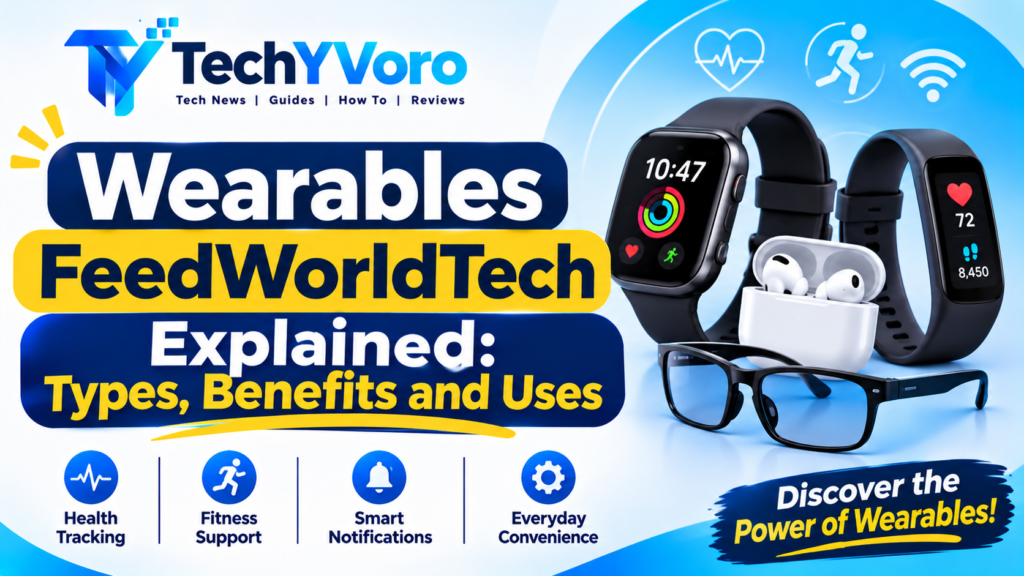
Wearables FeedWorldTech is a useful search phrase for exploring modern wearable technology, including smartwatches, fitness trackers, smart rings, smart glasses, and connected health devices. Wearable technology refers to electronic devices designed to be worn on the body or integrated into clothing to collect information, support communication, and perform everyday tasks. These devices use sensors, software, wireless connectivity, and sometimes artificial intelligence (AI) to provide useful features for fitness, healthcare, productivity, and personal convenience.
This guide explains how wearable devices work, their different types, practical applications, benefits, limitations, privacy concerns, and future developments. It also explores what to consider before choosing a wearable device.
What Is Wearable Technology?
Wearable technology refers to electronic devices designed to be worn on the body, either as accessories, clothing, or medical equipment. These devices combine hardware, sensors, software, and connectivity to perform specific functions.
Unlike traditional computers that remain on a desk or in a bag, wearable devices are designed to operate while users move through their daily activities.
Common examples include:
- Smartwatches that display notifications and track selected health metrics.
- Fitness trackers that record steps, activity, and exercise sessions.
- Smart rings that monitor selected wellness measurements.
- Smart glasses that provide digital information through a visual interface.
- Medical wearable devices that monitor specific health conditions.
- Smart clothing that incorporates sensors into fabric.
Wearables can serve different purposes depending on their design. Some focus on convenience and entertainment, while others are developed for fitness monitoring, medical applications, or workplace safety.
The term Wearables FeedWorldTech in this article refers to the broader subject of connected wearable technology rather than a verified manufacturer, product, or technical standard.
Readers interested in exploring more software solutions can also check out 8tshare6a Software Guide to learn about its features, functionality, potential uses, and important details.
Types of Wearable Devices
Wearable technology includes several device categories, each designed to address different needs.
Smartwatches
Smartwatches are wrist-worn electronic devices that combine timekeeping with smartphone connectivity, applications, and selected health-monitoring features.
Depending on the model, they may offer:
- Call and message notifications.
- Step and activity tracking.
- Heart-rate monitoring.
- Sleep tracking.
- GPS navigation.
- Music controls.
- Contactless payments.
- Selected emergency and safety features.
Some advanced models also provide ECG functionality or blood oxygen estimates, subject to device availability and regional restrictions.
Smartwatches are particularly useful for people who want notifications, fitness information, and everyday digital features in one device.
Fitness Trackers
Fitness trackers are designed primarily to monitor physical activity and selected wellness measurements.
Common features include step counting, distance estimation, exercise tracking, heart-rate monitoring, and sleep-related information.
Many fitness bands are smaller and simpler than smartwatches. Their compact design may make them suitable for users who prefer basic activity monitoring without a large screen or extensive applications.
However, available features and measurement accuracy differ between models.
Smart Rings
Smart rings are compact wearable devices worn on a finger. They may contain sensors that collect information about movement, heart rate, skin temperature, and sleep-related patterns.
Their small size makes them an alternative for people who do not want to wear a smartwatch throughout the day.
Some smart rings provide wellness summaries through connected mobile applications. Their features, subscription requirements, battery performance, and compatibility should be checked before purchasing.
Smart Glasses
Smart glasses integrate digital technology into eyewear. Depending on their design, they may include cameras, microphones, speakers, displays, voice controls, or augmented reality features.
Possible applications include:
- Hands-free communication.
- Audio playback.
- Photography and video recording.
- Navigation assistance.
- Digital information overlays.
- Workplace instructions and remote support.
Not every smart-glasses product includes a visual display. Some focus mainly on cameras, audio, or voice-based interaction.
Wearable Medical Devices
Medical wearables are designed for specific healthcare purposes, such as monitoring health conditions or collecting physiological measurements.
Examples include certain ECG monitors, continuous glucose monitoring systems, connected blood pressure devices, and wearable cardiac patches.
These devices differ from ordinary consumer fitness trackers because their intended medical functions may require additional validation and regulatory oversight.
The U.S. Food and Drug Administration maintains information about sensor-based digital health medical devices:
Readers interested in the latest technology insights can also explore Tech Guru WaveTechGlobal to discover useful tech updates, digital trends, and information about emerging technologies.
How Does Wearable Technology Work?
Wearable technology works by combining sensors, processing components, software, and communication technologies. These components collect information, interpret measurements, and present results through the device or a connected application.
A typical wearable system follows this process:
- Sensors collect information from the user’s movement or body.
- The device’s processor handles the collected signals.
- Software interprets the information using programmed calculations or algorithms.
- The device displays results or transfers information to a compatible application.
- The application may store, organize, or synchronize the information with a connected service.
Not every wearable follows the same process. Some devices perform most processing locally, while others depend more heavily on a smartphone or cloud-based service.
Sensors and Data Collection
Sensors are essential components of modern wearable devices. They detect physical movement, body-related signals, or environmental conditions.
Common examples include:
| Sensor | Main function | Typical application |
|---|---|---|
| Accelerometer | Measures acceleration and movement | Step counting and activity tracking |
| Gyroscope | Measures rotational movement | Motion tracking and orientation |
| Optical heart-rate sensor | Detects changes in blood volume using light | Heart-rate estimation |
| GPS receiver | Determines geographic location | Distance and route tracking |
| Temperature sensor | Measures temperature at the sensor | Skin-temperature trends |
| ECG sensor | Records electrical signals from the heart | Selected cardiac monitoring |
| Ambient light sensor | Detects surrounding light levels | Automatic display adjustment |
The exact sensors depend on the device and its intended purpose. A basic fitness band may include only a few motion and optical sensors, while a medical monitoring device may use specialized components.
Wireless Connectivity
Wearables often use wireless technologies to communicate with smartphones, computers, and online services.
Bluetooth is commonly used for short-range communication between a wearable and a smartphone. Some devices also support Wi-Fi or cellular connectivity.
GPS can provide location information when supported by the device. It is a positioning technology rather than a general-purpose communication connection.
According to the CDC, many wearable devices use low-powered radiofrequency transmitters to exchange information with nearby devices or the internet.
Mobile Applications and Cloud Processing
Many wearable devices work alongside mobile applications.
These applications can display activity records, organize health measurements, manage device settings, and synchronize information across compatible services.
Cloud-based processing may provide additional storage, data analysis, and access across multiple devices.
However, cloud synchronization is not necessary for every wearable feature. Some functions can operate directly on the device without an internet connection.
Users should review application permissions and data-sharing settings because connected services may handle sensitive personal information.
Common Applications of Wearable Technology
Wearable technology has applications in everyday activities, fitness, healthcare, communication, and professional environments.
Health and Fitness Monitoring
Health and fitness monitoring is one of the most familiar uses of wearable devices.
Depending on the model, a wearable may track:
- Daily steps.
- Exercise duration.
- Heart rate.
- Estimated calories burned.
- Sleep patterns.
- Workout intensity.
- Selected blood oxygen measurements.
These features can help users understand activity patterns and observe changes over time.
However, measurements are not equally accurate across all devices and activities. Wrist movement, device fit, skin contact, sensor design, and the type of exercise can affect readings.
Wearable measurements should therefore be treated as estimates unless the specific device and measurement have been appropriately validated.
Healthcare and Remote Patient Monitoring
Wearable medical technology can help collect health information outside traditional clinical environments.
For example, certain connected devices can monitor cardiac activity or glucose levels and provide information to healthcare professionals.
Remote patient monitoring may help clinicians observe selected measurements between appointments, particularly when a patient requires ongoing monitoring.
The U.S. Government Accountability Office’s 2026 assessment explains that wearables may support more timely and personalized care, but also highlights differences in reliability and challenges involving clinical integration.
This means wearable technology can support healthcare, but it does not automatically replace medical examinations, laboratory testing, or professional diagnosis.
Communication and Everyday Productivity
Smartwatches and other connected wearables can make everyday communication more convenient.
Users may receive notifications, check messages, control music, access voice assistants, or respond to selected calls without taking out a smartphone.
Some devices also support reminders, calendar alerts, navigation, and contactless payments.
These features can be useful when users are exercising, commuting, working, or performing activities where accessing a phone is inconvenient.
Sports and Workplace Applications
Wearables are also used in sports and professional environments.
Athletes may use activity trackers, GPS-enabled devices, and motion sensors to review training sessions and understand physical performance.
In workplaces, specialized wearable systems may help monitor equipment conditions, provide hands-free instructions, or support safety procedures.
Industrial applications require careful implementation because sensor readings, alerts, and automated systems must be suitable for the specific working environment.
The Role of Artificial Intelligence in Wearable Technology
Artificial intelligence is expanding the ways wearable devices can interpret collected information.
Traditional wearables often rely on programmed rules and calculations. AI-based systems may analyze larger amounts of data, recognize patterns, and generate personalized recommendations.
Personalized Recommendations
Some wearable applications analyze activity and sleep information to provide suggestions based on user patterns.
For example, an application might identify changes in daily activity or show how exercise habits relate to sleep records.
These recommendations depend on the quality of the underlying data and should not be treated as guaranteed health improvements.
Predictive Health Insights
AI may help identify unusual patterns in wearable measurements and highlight information that deserves further attention.
Researchers are exploring how continuous health data could support earlier identification of certain changes.
However, detecting a statistical pattern does not necessarily mean a device can diagnose a medical condition. Clinical usefulness depends on appropriate validation, intended use, and professional interpretation.
Intelligent Automation
AI can also improve wearable interactions through voice recognition, contextual notifications, and activity classification.
For example, a device may identify a workout automatically or provide information based on a user’s selected preferences.
These features can make wearables easier to use, although AI-powered functions may introduce additional processing, battery, privacy, and reliability considerations.
Benefits of Wearable Technology
Wearable devices offer several practical advantages when their features match the user’s needs.
Better Activity Awareness
Fitness trackers and smartwatches can make daily movement more visible by recording steps, exercise sessions, and selected activity measurements.
This information may help users recognize inactive periods and establish realistic activity goals.
Greater Convenience
Wearables provide quick access to selected digital features without requiring users to reach for a smartphone.
Notifications, music controls, navigation, and reminders can make everyday tasks more convenient.
Continuous Data Collection
Certain devices can collect measurements throughout the day or during specific activities.
Long-term records may help users identify patterns that would be difficult to notice from occasional measurements.
Personalized Experiences
Wearable applications can organize information according to user preferences, activity goals, and device capabilities.
Some systems use algorithms or AI to provide customized summaries and recommendations.
Support for Remote Monitoring
Appropriately designed medical wearables can help healthcare professionals receive selected measurements from patients outside clinical settings.
This may be valuable for certain monitoring programs, although reliability, access, and clinical workflows remain important considerations.
Readers dealing with software errors can also explore How to Fix a Bug on EveBiohazTech to learn about common issues, possible causes, and troubleshooting steps.
Limitations and Challenges of Wearable Devices
Despite their advantages, wearable devices have limitations that users should understand before relying on them.
Battery Life
Small wearable devices have limited space for batteries. Features such as GPS, bright displays, continuous monitoring, and frequent wireless synchronization can increase power consumption.
Battery performance also varies with usage, settings, hardware, and battery age.
Users should compare realistic battery-life expectations rather than relying only on manufacturer estimates.
Accuracy of Health Measurements
Wearable health readings are not always identical to measurements obtained through clinical equipment.
A systematic review of consumer wearable technologies found substantial variation in accuracy across devices and health measurements.
For example, heart-rate estimates may perform differently during rest and exercise. Sleep tracking may also produce estimates that differ from clinical sleep assessments.
Device fit, movement, skin contact, sensor design, and software algorithms can all influence results.
Device Compatibility
Not every wearable works with every smartphone or operating system.
Before purchasing, users should check:
- Supported Android or iOS versions.
- Required companion applications.
- Bluetooth compatibility.
- Available features on their phone.
- Account and subscription requirements.
- Regional feature availability.
- Integration with other health or fitness platforms.
A device may physically connect to a phone but still lack certain features because of software or regional restrictions.
Cost and Subscription Requirements
The purchase price is not always the total cost of owning a wearable.
Some products require subscriptions for advanced analytics, cloud services, or additional application features.
Accessories, replacement bands, charging equipment, and repairs may also increase long-term costs.
Wearable Technology Security and Privacy
Wearable devices can collect sensitive information, including movement patterns, location, activity records, and selected health measurements.
The way this information is stored, transferred, and shared depends on the manufacturer, application, and connected services.
What Data Do Wearables Collect?
Depending on the device, collected information may include:
- Physical activity and movement.
- Heart-rate measurements.
- Sleep-related information.
- Location and exercise routes.
- Device usage information.
- Personal profile details.
- Information synchronized with connected applications.
Not every wearable collects all these categories.
Common Privacy and Security Risks
Potential concerns include weak account security, unnecessary application permissions, insecure data sharing, excessive information collection, and unauthorized account access.
Health information also deserves special attention. The U.S. Federal Trade Commission explains that many consumer health applications and connected services may fall outside the HIPAA framework that applies to certain healthcare organizations.
This makes it important to understand a service’s privacy practices rather than assuming every health application follows the same legal requirements.
How to Protect Personal Information
Users can reduce avoidable risks by following these practices:
- Use a strong, unique password for the wearable account.
- Enable multifactor authentication when available.
- Review application permissions regularly.
- Disable unnecessary location or data-sharing features.
- Install official device and application updates.
- Avoid connecting the device to untrusted applications.
- Read the manufacturer’s privacy policy.
- Delete old accounts and stored information when no longer needed, where supported.
For additional guidance, see the FTC’s information on health data privacy and breach notification.
Smartwatch vs. Fitness Tracker vs. Smart Ring
Smartwatches, fitness trackers, and smart rings have overlapping features, but they are designed for different priorities.
| Feature | Smartwatch | Fitness Tracker | Smart Ring |
|---|---|---|---|
| Main purpose | Digital convenience and fitness | Activity monitoring | Compact wellness tracking |
| Screen | Usually included | Small screen or no screen | Usually no screen |
| Notifications | Common | Limited on many models | Generally limited |
| Activity tracking | Common | Core feature | Available on selected models |
| Health monitoring | Model-dependent | Model-dependent | Model-dependent |
| Battery life | Varies by model and usage | Often longer than feature-rich watches | Varies by model |
| Comfort | Depends on size and design | Usually lightweight | Depends on fit and ring size |
| Best suited for | Everyday connected features | Fitness-focused users | People preferring a compact wearable |
No category is automatically better for everyone.
A smartwatch may be more suitable for someone who wants notifications and applications. A fitness tracker may suit someone who mainly wants activity records, while a smart ring may appeal to users who prefer a smaller device.
How to Choose the Right Wearable Device
Choosing a wearable device becomes easier when you identify the features that matter most.
Identify Your Main Requirements
Start by deciding why you want a wearable.
Your priorities may include:
- Fitness and exercise tracking.
- Sleep-related information.
- Smartphone notifications.
- GPS and navigation.
- Medical monitoring.
- Workplace or sports applications.
- A compact and comfortable design.
Avoid paying for features that you are unlikely to use.
Compare Features and Specifications
Compare devices using the same criteria.
Look at sensor capabilities, supported applications, display quality, connectivity, water resistance, battery life, and available software updates.
For health-related features, check the exact measurement the device supports and whether it is intended for general wellness or a medical purpose.
Check Compatibility
Confirm that the wearable supports your smartphone, operating system, and preferred applications.
Some advanced features may require a particular phone brand, operating system version, regional account, or subscription.
Consider Comfort and Battery Life
A wearable should be comfortable enough for its intended use.
Check its weight, dimensions, strap material, charging method, and expected battery performance.
For devices intended for sleep monitoring, comfort during overnight use is particularly important.
Review Privacy and Long-Term Costs
Before buying, read the privacy policy and understand what information the companion application collects.
Also check whether advanced features require recurring payments.
A reasonably priced device with suitable features may provide better long-term value than a more expensive model with unnecessary extras.
Future Trends in Wearable Technology
Wearable technology continues to develop as sensors, wireless communication, software, and AI improve.
Advanced Health Monitoring
Researchers are exploring new ways to collect physiological measurements through wearable sensors.
Future devices may provide more useful information about selected health conditions, although each application will require appropriate testing and validation.
AI-Powered Wearables
AI may help wearables identify patterns, organize health information, and provide more contextual recommendations.
However, more intelligent software does not automatically mean more accurate measurements or reliable medical decisions.
Augmented Reality Smart Glasses
Smart glasses may offer increasingly useful hands-free digital experiences through cameras, displays, voice interfaces, and contextual information.
Possible applications include navigation, remote assistance, workplace training, and accessibility support.
Better Connected Device Ecosystems
Wearables may become more integrated with smartphones, healthcare platforms, smart-home devices, and other connected systems.
This could improve convenience but will also make interoperability, privacy, and security increasingly important.
The direction of wearable technology will depend not only on innovation but also on affordability, comfort, battery performance, consumer trust, and reliable real-world applications.
Readers who want to understand the basics of business promotion can also explore Marketing Fundamentals: A Beginner’s Guide to learn about marketing principles, target audiences, branding, and effective promotional strategies.
Frequently Asked Questions
What is Wearables FeedWorldTech?
Wearables FeedWorldTech is the focus phrase used for this guide to wearable technology. It covers devices such as smartwatches, fitness trackers, smart rings, smart glasses, and connected health-monitoring products. It should not be confused with a verified wearable technology manufacturer or industry standard.
What are the different types of wearable devices?
Common types include smartwatches, fitness bands, smart rings, smart glasses, smart clothing, and medical wearable devices. Their features depend on their design and intended purpose.
How do wearable devices track health?
Wearables use sensors to collect information such as movement, heart-rate signals, and temperature-related measurements. Their software processes the signals and displays results through the device or a connected application.
How accurate are wearable fitness trackers?
Accuracy varies according to the device, measurement, activity, and testing conditions. Step counts and heart-rate estimates may be useful for general tracking, but other measurements can have substantial limitations. Clinical decisions should not rely solely on an ordinary consumer fitness tracker.
Are wearable devices safe to use?
Most consumer wearables are designed for regular use, but users should follow manufacturer instructions, maintain appropriate device hygiene, and review privacy settings. Medical concerns should be discussed with a qualified healthcare professional.
Can wearable technology replace medical equipment?
No, ordinary consumer wearables should not automatically replace medical equipment. Only devices intended and appropriately authorized for specific medical functions should be used for those purposes. For example, the FDA has warned against relying on smartwatches or smart rings that claim to measure blood glucose independently without an appropriate measurement method.
What are the main benefits of wearable technology?
The main benefits include activity tracking, convenient notifications, selected health monitoring, personalized information, and support for certain remote healthcare applications.
How can I protect my wearable device data?
Use strong passwords, enable multifactor authentication, review application permissions, install updates, and limit unnecessary data sharing. Check the privacy policies of both the device manufacturer and connected applications.
Conclusion
Wearables FeedWorldTech provides a useful starting point for understanding the growing field of wearable technology. From smartwatches and fitness trackers to smart rings and medical monitoring devices, wearables combine sensors, software, and wireless connectivity to support everyday activities and specialized applications.
Their benefits include greater convenience, activity awareness, and access to selected health information. However, measurement accuracy, battery life, compatibility, privacy, and security remain important considerations.
The best wearable device is not necessarily the one with the most features. It is the one that meets your requirements, works with your existing devices, protects your information, and provides reliable value for its intended purpose.
As wearable technology develops, informed users will benefit most by understanding both what these devices can do and where their limitations begin.
Readers can explore TechyVoro for more helpful technology guides, software tutorials, AI updates, and the latest digital trends.



One Comment