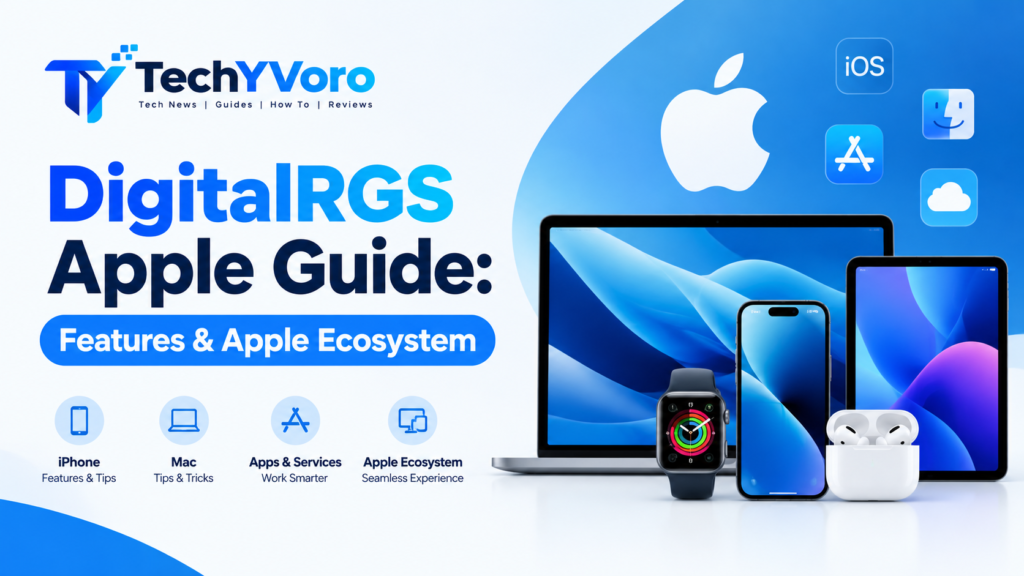
DigitalRGS Apple Guide: Features & Apple Ecosystem
 Mian Bilal Ch
The DigitalRGS Apple Guide is a search phrase associated with online explanations of Apple’s devices, software, connected services, and ecosystem features. However, the name alone does not establish that DigitalRGS is an official Apple product, application, or support service. Readers should verify the publisher’s identity before relying on claims about its ownership, features, or affiliation.
Understanding the Apple ecosystem can help you use an iPhone, iPad, Mac, Apple Watch, and related services more effectively. This guide explains the DigitalRGS search term, explores important Apple features, covers practical setup and security considerations, and shows how to verify technology information before acting on it.
If you enjoy exploring practical technology topics, visit TechyVoro for technology news, software explanations, and digital guides.
Quick Answer: What Is DigitalRGS Apple Guide?
The DigitalRGS Apple Guide is a search term associated with third-party content about Apple technology and the connected Apple ecosystem. Available search results discuss topics such as iPhone and Mac features, iCloud, device integration, security, setup, and troubleshooting. However, the exact identity and official status of DigitalRGS have not been independently established here.
Apple’s ecosystem is the verified technology behind many of these topics. It includes Apple hardware, operating systems, account services, and features that let compatible devices share content or continue tasks across devices. For current specifications, compatibility, security instructions, and software availability, Apple’s official documentation is the appropriate reference.
What Does DigitalRGS Apple Guide Mean?
The phrase combines the name DigitalRGS with a broad interest in Apple products and services. It may be used by people looking for an overview of Apple’s technology, practical device advice, or explanations of how its products work together.
There is an important distinction between a guide about Apple and a resource published or endorsed by Apple.
An independent technology website can explain Apple products without being affiliated with Apple Inc. Likewise, an article’s title does not establish that a named platform owns a particular application, offers a proprietary service, or has conducted product testing.
Before trusting a DigitalRGS-specific claim, check the publisher’s actual website, author information, publication history, and supporting evidence. If the article discusses a particular Apple feature, verify that feature separately against Apple’s documentation.
What Is the Apple Ecosystem?
The Apple ecosystem refers to Apple’s connected devices, software, services, and cross-device features. These components can work together to make everyday tasks more convenient.
For example, you might take a photograph on an iPhone, edit it on a Mac, review a document on an iPad, and receive notifications on an Apple Watch. The exact experience depends on the devices, software versions, account configuration, and features involved.
The ecosystem includes several main components:
| Component | Main purpose |
|---|---|
| iPhone | Mobile communication, apps, photography, and everyday tasks |
| iPad | Portable computing, reading, creative work, and productivity |
| Mac | Desktop or laptop computing for work, study, and development |
| Apple Watch | Wrist-based notifications, fitness features, and health-related functions |
| iCloud | Cloud storage and synchronization for supported content and services |
| Apple Account | Account access and settings across Apple services |
| Continuity | Features that connect compatible Apple devices and workflows |
Not every device needs to be purchased for the ecosystem to be useful. A single iPhone can be valuable on its own, while adding a compatible Mac or iPad can provide additional cross-device conveniences.
Why Is the Apple Ecosystem Popular?
Apple’s ecosystem appeals to users who value integration between devices, consistent software experiences, and convenient access to their information.
Its potential benefits include:
- Connected workflows: Continue certain tasks on another compatible device.
- Convenient sharing: Transfer photos, documents, and other supported content.
- Integrated services: Access supported information through an Apple Account and iCloud.
- Security features: Use supported authentication, account protection, and device security controls.
- Consistent interfaces: Familiar software patterns across several Apple products.
There are trade-offs. Apple hardware can require a substantial initial investment, some services require subscriptions, and particular cross-device features depend on compatibility. Users who rely on Windows, Android, or other platforms should check their specific requirements before choosing a device.
The best ecosystem is the one that fits your actual needs, budget, accessibility requirements, and existing technology.
Meet Apple’s Main Products and Operating Systems
Apple’s products serve different purposes, and their software determines which capabilities are available.
iPhone and iOS
The iPhone runs iOS and supports communication, photography, applications, navigation, and other mobile tasks. Its available features vary by model, software version, region, and installed applications.
iPad and iPadOS
iPadOS supports tablet-focused workflows, including document editing, drawing, multitasking, and media consumption. Some capabilities overlap with Mac workflows, but an iPad is not a complete substitute for every desktop application or task.
Mac and macOS
macOS powers Apple’s Mac computers. It is suited to desktop applications, programming, content creation, multitasking, and productivity workflows that benefit from a larger display and conventional computer environment.
Apple Watch and watchOS
Apple Watch provides notifications, activity tracking, and other supported features. Some functions rely on an associated iPhone, connectivity, regional availability, or compatible hardware.
Other Apple platforms
Apple also develops software for products such as Apple TV and Apple Vision Pro. Their capabilities and requirements differ from those of an iPhone or Mac, so compatibility should be checked for the specific product and task.
How Apple Devices Work Together
Apple’s Continuity features help compatible devices exchange content or continue supported activities. These features are useful, but they are not universal: requirements vary by feature and operating-system version.
AirDrop: Share Files Between Devices
AirDrop lets users share supported files with nearby compatible Apple devices.
A typical workflow is:
- Turn on AirDrop and select the appropriate receiving setting.
- Choose the file, photograph, or other supported item.
- Open the sharing options and select AirDrop.
- Choose the intended recipient.
- Accept the transfer if prompted.
If AirDrop fails, check that the receiving device is discoverable, both devices support the feature, and their wireless settings meet Apple’s requirements. Review the current Apple AirDrop and Continuity guidance for supported workflows.
Handoff: Continue a Task on Another Device
Handoff lets you begin certain activities on one device and continue them on another. For example, you might start composing an email on an iPhone and finish it on a Mac.
Compatible devices generally need to be signed in with the same Apple Account, with Wi-Fi, Bluetooth, and Handoff enabled as required. The app or activity must also support the feature.
Apple explains the setup and usage requirements in its official Handoff support guide.
Universal Clipboard: Copy and Paste Across Devices
Universal Clipboard lets you copy supported content on one compatible Apple device and paste it on another.
For example, you could copy a paragraph on an iPhone and paste it into a document on a nearby Mac. The feature relies on the required account, proximity, wireless settings, and supported software.
See Apple’s Universal Clipboard instructions for setup requirements and troubleshooting.
Continuity Camera
Continuity Camera allows supported Apple devices to use an iPhone camera in compatible Mac workflows, including supported video and document-scanning tasks.
Its usefulness depends on the particular device combination, software versions, and application. Consult Apple’s current Continuity overview before assuming a feature will work on your hardware.
Apple Account and iCloud: What You Need to Know
An Apple Account provides access to Apple’s services and account-related settings. iCloud supports features such as syncing supported information, storing files, and maintaining backups for compatible devices and services.
These are related but different functions.
Your account establishes access to services, while individual iCloud features determine which information is synchronized, stored, or backed up. Enabling one feature does not automatically mean that every type of content is protected by a backup.
For a safer setup:
- Use a strong, unique account password.
- Enable two-factor authentication where available.
- Review trusted devices and account-recovery options.
- Check which apps and data use iCloud.
- Confirm that backups are completing successfully.
- Review available storage before relying on cloud backups.
Do not share verification codes with anyone claiming to provide unsolicited account support. For account problems, use Apple’s official support channels rather than unfamiliar links or third-party download offers.
Apple Intelligence and Siri
Apple Intelligence refers to Apple’s AI-related capabilities available on supported devices and software configurations. Siri is Apple’s voice assistant, and its capabilities and integration with other features can vary.
Before relying on a particular AI function, check:
- Whether your device meets the relevant hardware requirements.
- Whether the installed operating system supports the feature.
- Whether your language and region are supported.
- Whether the capability requires an internet connection or additional setup.
- How the feature processes information and what privacy controls are available.
Do not assume that every iPhone, iPad, or Mac supports every Apple Intelligence capability. Availability and functionality can change with software updates.
For current details, use Apple’s official website and product documentation rather than treating a third-party guide as definitive.
Privacy and Security Features Worth Understanding
Apple devices include security and privacy controls, but users still need to configure their accounts and devices responsibly.
Face ID and Touch ID
These features provide supported biometric authentication. Availability depends on the device model. Keep a secure passcode as a backup and avoid sharing device credentials.
App Tracking Transparency
This framework gives users controls over certain app-tracking requests. It does not mean that all data collection across websites, services, or applications is automatically prevented.
iCloud Keychain and Password Management
Supported password-management features can help users store and manage credentials. Use unique passwords, protect account access, and review saved credentials when necessary.
Lockdown Mode
Lockdown Mode is an optional protective setting intended for people who may face highly sophisticated targeted digital threats. It restricts certain device functions and is not necessary for every user.
Practical security checklist
- Install security updates promptly when appropriate.
- Use a strong device passcode.
- Enable available account-protection measures.
- Review application permissions.
- Verify links before entering credentials.
- Maintain backups and check that they work.
- Avoid installing profiles, applications, or configuration files from untrusted sources.
Security features reduce certain risks, but no single setting makes a device invulnerable.
Common Apple Ecosystem Problems and Solutions
| Problem | What to check |
|---|---|
| AirDrop is not working | Discoverability, receiving settings, device compatibility, and wireless connectivity |
| iCloud is not syncing | Account status, network access, available storage, and the relevant sync setting |
| Mac does not recognize an iPhone | Cable or connection quality, trust prompts, software compatibility, and device settings |
| Handoff is unavailable | Same account, Wi-Fi, Bluetooth, Handoff settings, and app support |
| Battery drains quickly | Battery usage by app, recent software changes, signal conditions, and battery health |
| Universal Clipboard fails | Device proximity, account sign-in, Handoff, Bluetooth, Wi-Fi, and supported software |
Start with the relevant settings and official support documentation before resetting a device or deleting data. If a problem began after an update, identify the exact device and software version so that the troubleshooting steps match your configuration.
Choosing the Right Apple Device
The best Apple product depends on how you plan to use it rather than on how many devices you can connect.
| User type | Possible starting point | Main consideration |
|---|---|---|
| Student | iPhone or iPad, depending on study needs | Required apps, note-taking, portability, and budget |
| Office professional | Mac or iPad | Work software, keyboard needs, and compatibility |
| Content creator | Mac, iPad, or iPhone | Editing requirements, file sizes, display, and performance |
| Everyday user | iPhone | Communication, camera needs, storage, and cost |
| Existing Apple user | Add a compatible device only if useful | Incremental benefit versus total cost |
Before purchasing, compare current prices, supported software, storage options, repair arrangements, warranty terms, and the applications you actually need. Do not assume the most expensive product is automatically the best choice.
Frequently Asked Questions
Is DigitalRGS Apple Guide an official Apple resource?
Its official status has not been established by the evidence reviewed for this article. Treat it as a search term associated with third-party Apple-related content unless reliable evidence confirms a specific publisher or affiliation.
What does DigitalRGS Apple Guide cover?
Search results associate the phrase with Apple devices, software, connected services, device setup, security, troubleshooting, and ecosystem features. The precise scope depends on the individual publisher and article.
Do I need multiple Apple devices to use the ecosystem?
No. An individual Apple device can be useful on its own. Additional devices can enable more connected workflows, provided they meet the requirements of the features you want.
What is the difference between iOS and macOS?
iOS is the operating system for iPhone, while macOS powers Mac computers. They serve different hardware and workflows, although some applications and services work across both platforms.
Is iCloud required for every Apple feature?
No. Requirements differ by feature. Some functions rely on iCloud or the same Apple Account, while others can work without the same cloud-service configuration.
Is Apple Intelligence available on every Apple device?
No. Availability depends on supported hardware, software, language, region, and the particular capability. Verify the requirements for the feature you intend to use.
How can I make Apple devices more secure?
Use strong authentication, enable available account-protection measures, install updates, review permissions, and maintain backups. For high-impact security decisions, consult official Apple guidance.
What should I do if an Apple feature does not work?
Check compatibility, software versions, account settings, connectivity, and the feature’s official setup requirements. Avoid drastic resets until you have identified the likely cause and protected important data.
Final Thoughts
The DigitalRGS Apple Guide topic is best approached as an opportunity to understand Apple’s connected technology while carefully distinguishing verified product information from unverified claims about a publisher or platform.
Features such as AirDrop, Handoff, Universal Clipboard, iCloud, and supported AI capabilities can make Apple devices more useful when configured correctly. Their availability and limitations still depend on the specific hardware, software, settings, and region.
Use third-party guides as a starting point, confirm important details with official documentation, and choose devices according to your actual needs. That approach provides more dependable guidance than relying on a name, headline, or broad promise of exclusive discoveries.