Digital Marketing 101: Basics, Types, Examples & How to Start
 Mian Bilal Ch
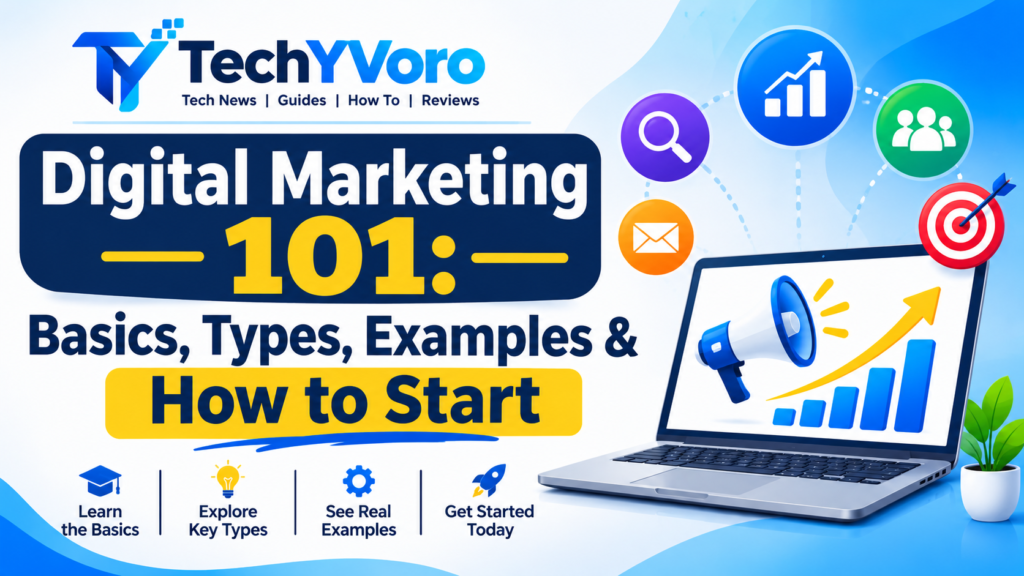
Digital marketing is the process of promoting products, services, or brands through online channels such as search engines, websites, social media, email, and digital advertisements. It helps businesses reach relevant audiences, build brand awareness, attract potential customers, and measure their marketing performance.
For beginners, understanding digital marketing starts with learning how its main channels work and how they support business goals. You do not need to use every platform at once. A clear objective, a useful message, and the right channel are more important than being active everywhere.
This Digital Marketing 101 guide explains the essential concepts, major types, practical examples, beginner-friendly tools, and steps for creating a simple digital marketing strategy.
What Is Digital Marketing?
Digital marketing refers to marketing activities that use digital technologies and online platforms to connect businesses with potential customers. These activities can include publishing website content, appearing in search results, sharing social media posts, sending email campaigns, and running paid advertisements.
For example, a small clothing store might publish product guides to attract search traffic, share new arrivals on Instagram, collect email subscribers, and run paid ads for a seasonal promotion. Each activity supports the same business goal through a different digital channel.
Digital Marketing in Simple Words
In simple terms, digital marketing means reaching people online and encouraging them to take a useful action.
That action might be:
- Visiting a website.
- Reading an article or watching a video.
- Subscribing to an email newsletter.
- Requesting a quote.
- Booking a service.
- Purchasing a product.
Unlike traditional marketing methods that often rely on print, television, or physical advertising, digital marketing gives businesses more ways to interact with audiences and evaluate campaign activity.
Discover the best marketing communities where marketers can connect with industry professionals, share knowledge, discuss strategies, learn new skills, and stay updated on the latest digital marketing trends.
Digital Marketing vs. Traditional Marketing
Both approaches aim to connect businesses with customers, but they use different channels and measurement methods.
| Digital marketing | Traditional marketing |
|---|---|
| Uses websites, search engines, email, and social platforms | Uses television, radio, print, and outdoor advertising |
| Can target specific audience groups | Often reaches broader audiences |
| Offers digital performance tracking | May rely on surveys, circulation, or estimated reach |
| Can support direct online interaction | Often uses one-way communication |
| Budgets can range from small to large | Some formats require substantial upfront spending |
Neither approach is automatically better. The right choice depends on the audience, budget, product, location, and campaign objective. Some businesses combine both.
How Does Digital Marketing Work?
Digital marketing works by connecting a business’s goals with the needs and online behavior of its target audience. A campaign usually follows a sequence: research, planning, content or advertising, audience engagement, and performance measurement.
1. Understand Your Audience and Goals
Start by identifying who you want to reach. Consider their needs, interests, common problems, location, and the questions they ask before making a purchase.
Then define a measurable objective. Examples include:
- Increasing relevant website visits.
- Generating qualified leads.
- Growing newsletter subscriptions.
- Increasing online sales.
- Improving customer retention.
A clear goal helps you choose suitable channels and decide which results matter.
2. Choose Channels and Create Useful Content
Select the platforms where your audience is most likely to discover and engage with your business. A service provider might focus on local search and informative website pages, while a visual product brand may benefit from social media and video.
Create content that answers customer questions or helps them make decisions. Depending on the channel, this could include articles, product pages, short videos, email newsletters, or advertisements.
3. Measure and Improve Performance
After publishing content or launching a campaign, review the results. Look at the metrics connected to your original objective rather than judging success by views or likes alone.
For example, if your goal is to generate leads, track completed enquiry forms and qualified enquiries. Use the findings to improve your message, landing page, audience targeting, or channel selection.
What Are the Main Types of Digital Marketing?
Digital marketing includes several connected disciplines. Businesses can combine them, but beginners should understand what each one does before investing time or money.
1. Search Engine Optimization (SEO)
SEO is the practice of improving website content and structure so search engines can understand it and users can discover it through relevant search results.
Common SEO activities include:
- Researching topics and search terms.
- Creating helpful, well-organized content.
- Improving page titles and headings.
- Making websites easy to navigate.
- Fixing technical issues that affect crawling or usability.
- Earning relevant links and building credibility.
SEO is generally a long-term approach. It does not guarantee a particular ranking or a specific amount of traffic.
2. Search Engine Marketing (SEM)
Search engine marketing is commonly used to describe paid search advertising, although some people use SEM more broadly to include both paid search and SEO.
With paid search campaigns, businesses bid to show advertisements for relevant search queries. Advertisers may pay when someone clicks an ad, depending on the campaign and bidding model.
SEO and paid search can complement each other: SEO focuses on organic visibility, while paid search can provide advertising exposure when campaigns are properly configured and funded.
3. Content Marketing
Content marketing involves creating and distributing useful information to attract and engage a defined audience.
Examples include:
- Educational blog posts.
- How-to guides and tutorials.
- Videos and explainers.
- Downloadable resources.
- Case studies.
- Product comparisons.
A good content plan focuses on real audience questions rather than publishing articles simply to fill a website. For a deeper explanation, read TechyVoro’s Web Content Strategy guide.
4. Social Media Marketing
Social media marketing uses platforms such as Facebook, Instagram, LinkedIn, TikTok, and YouTube to build awareness, share content, communicate with audiences, and support business objectives.
Activities may include publishing posts, responding to comments, sharing videos, collaborating with creators, and running paid social campaigns.
The best platform depends on where your intended customers spend time and what type of content suits your business. See our guide on how to create a social media strategy.
5. Email Marketing
Email marketing uses email messages to communicate with people who have subscribed or otherwise provided permission to receive relevant communications.
Businesses use it for:
- Newsletters and educational updates.
- Product announcements.
- Welcome sequences.
- Promotional campaigns.
- Customer follow-ups.
- Retention and re-engagement.
Useful email marketing is relevant, clear, and respectful of subscriber preferences. Follow applicable privacy and anti-spam requirements, and provide an appropriate way to unsubscribe.
6. Pay-Per-Click (PPC) Advertising
PPC is an advertising model in which an advertiser pays when a user clicks an advertisement. Search ads are a common example, but PPC-style campaigns can also appear on other advertising platforms.
PPC can help businesses reach audiences more quickly than waiting for organic visibility to develop. However, clicks cost money, and results depend on factors such as targeting, competition, ad quality, landing-page experience, and budget.
7. Affiliate and Influencer Marketing
Affiliate marketing involves partners promoting a business’s products or services in exchange for a commission or another agreed reward when qualifying actions occur.
Influencer marketing involves working with creators who have an audience relevant to a brand. Partnerships may include sponsored posts, product demonstrations, reviews, or other agreed content.
Businesses should evaluate audience relevance, authenticity, disclosure practices, and measurable outcomes before choosing partners.
8. Video and Mobile Marketing
Video marketing uses recorded or live video to explain products, demonstrate services, answer questions, or tell brand stories. Mobile marketing focuses on reaching people through mobile devices and experiences, including mobile-friendly websites, apps, messaging, and mobile advertising.
Both can support other channels. For example, a tutorial video can be embedded in a blog post and shared through social media or an email newsletter.
Which Digital Marketing Channel Should Beginners Choose?
You do not need to start with every digital marketing channel. Choose based on your audience, resources, and immediate objective.
| Your goal | Channels to consider | Example activity |
|---|---|---|
| Attract people searching for answers | SEO and content marketing | Publish useful guides |
| Build an active community | Social media marketing | Share helpful posts and respond to comments |
| Reach people with immediate buying intent | Paid search advertising | Run targeted search campaigns |
| Keep in touch with interested customers | Email marketing | Send a useful newsletter |
| Demonstrate a product visually | Video and social media | Publish product demonstrations |
| Generate referrals through partners | Affiliate marketing | Create a tracked partner program |
For a beginner with a limited budget, starting with a useful website, a focused content plan, and one relevant social platform can be more manageable than trying to maintain every channel.
Understanding the Digital Marketing Funnel
The digital marketing funnel describes the stages a potential customer may move through before and after taking an action. It helps marketers match messages to audience needs.
Awareness
At this stage, people discover a brand or learn about a problem. Search content, educational videos, social media posts, and display advertising can help introduce a business.
Consideration
People compare options and look for more information. Product guides, case studies, email content, demonstrations, and comparison pages can help them evaluate possible solutions.
Conversion
A person takes an important action, such as making a purchase, booking a service, or submitting an enquiry. Clear calls to action, relevant offers, and straightforward landing pages can support this stage.
Retention
After the first conversion, businesses can continue providing value through customer support, useful email updates, loyalty programs, and relevant product recommendations.
Not every customer follows the same path. Someone may discover a brand through social media, research it through search, and return later through an email.
Practical Digital Marketing Examples
Consider a small online store that sells reusable water bottles.
- SEO: The store publishes a guide explaining how to choose a reusable water bottle.
- Content marketing: It creates an article comparing bottle materials and sizes.
- Social media: It shares product demonstrations and practical usage tips.
- Email marketing: Visitors can subscribe to receive product updates and useful advice.
- Paid advertising: The store tests a limited campaign aimed at people searching for relevant products.
- Analytics: The business reviews product-page visits, add-to-cart activity, completed purchases, and campaign costs.
These activities work together. SEO and content may help people discover the store, social media can build familiarity, email can support ongoing communication, and advertising can introduce products to selected audiences.
The business should keep the channels that contribute to meaningful results and improve or reconsider those that do not.
How to Create a Digital Marketing Strategy
A digital marketing strategy is a plan that explains what you want to achieve, whom you want to reach, which channels you will use, and how you will measure progress.
Follow these steps to create a practical beginner strategy.
Step 1: Set One Clear Goal
Choose a specific objective, such as increasing qualified enquiries or growing online sales. Avoid vague goals such as simply becoming popular online.
Step 2: Define Your Target Audience
Describe the people most likely to benefit from your product or service. Research their needs, questions, preferences, and decision-making process.
Step 3: Review Your Existing Online Presence
Check your website, social profiles, search visibility, content, and customer feedback. Identify what already works and what needs improvement.
Step 4: Select the Most Relevant Channels
Choose a manageable number of channels based on your audience and resources. A local service business may prioritize local search, while a visual brand may place more emphasis on video and social platforms.
Step 5: Create a Content and Campaign Plan
Decide what you will publish, where it will appear, and when it will be shared. Give each piece of content a clear purpose, such as answering a question, demonstrating a product, or encouraging an enquiry.
Step 6: Set a Budget and Track Results
Include the costs of advertising, software, content production, and any external support. Start with a budget you can afford to test, and review performance before increasing spending.
Step 7: Improve Based on Evidence
Use campaign data and customer feedback to identify opportunities. Test one meaningful change at a time where possible, and avoid assuming that more traffic automatically means better business results.
For a broader understanding of marketing principles behind these decisions, explore TechyVoro’s Marketing Fundamentals guide.
Essential Digital Marketing Tools for Beginners
You can learn the basics without buying a large collection of software. Start with tools that help you understand your audience, publish content, and measure results.
| Tool | Main purpose | Beginner use |
|---|---|---|
| Google Analytics 4 | Website and app measurement | Understand traffic and user interactions |
| Google Search Console | Search performance and website search visibility | Review search queries, clicks, and indexing information |
| Google Keyword Planner | Keyword research and advertising planning | Explore keyword ideas and advertising estimates |
| Google Trends | Explore search interest over time | Compare topics and identify changing interest |
| Canva | Visual content creation | Design social posts and simple graphics |
| Mailchimp | Email marketing | Create and manage email campaigns |
| Google Skillshop | Learning Google advertising and measurement products | Study courses and prepare for available certifications |
Tool features, free plans, limits, and availability can change, so check each provider’s official website before relying on a particular feature.
Useful starting resources include Google Analytics, Google Search Console, Google Trends, and Google Skillshop. Skillshop provides self-paced learning for Google products, including Google Ads.
How to Measure Digital Marketing Performance
Digital marketing measurement helps you understand whether your activities are supporting business goals. The most useful metrics depend on the objective and channel.
| Objective | Useful metrics |
|---|---|
| Increase website visibility | Search impressions, clicks, and relevant organic visits |
| Improve audience engagement | Meaningful interactions, video engagement, and engaged sessions |
| Generate leads | Form submissions, qualified leads, and cost per lead |
| Increase sales | Purchases, revenue, conversion rate, and customer acquisition cost |
| Improve email performance | Delivery, clicks, unsubscribes, and email-attributed actions |
| Evaluate paid campaigns | Ad spend, clicks, conversions, and return on ad spend |
A few common terms are worth understanding:
- Traffic: Visits or sessions on a website.
- Click-through rate (CTR): The percentage of impressions that result in clicks.
- Conversion rate: The percentage of relevant visitors or interactions that complete a defined action.
- Cost per lead (CPL): Advertising or campaign cost divided by the number of leads generated.
- Return on ad spend (ROAS): Revenue attributed to advertising divided by advertising spend.
In Google Analytics, important actions are called key events. A business can identify actions that matter to its success, such as a completed enquiry or purchase, and use them to understand user behavior. Google distinguishes Analytics key events from advertising conversions, which are used for measuring and optimizing ad campaigns. Read the official Google Analytics explanation of key events and conversions.
Do not judge a campaign using a single metric. A large number of clicks may look positive, but those clicks are less valuable if they do not reach the right audience or support the intended outcome.
Understand how long it takes to learn digital marketing, including the skills, learning stages, and practical experience needed to build a successful career in the digital marketing industry.
Common Digital Marketing Mistakes to Avoid
Beginners often make avoidable mistakes when they start promoting a business online.
| Mistake | Why it can cause problems | Better approach |
|---|---|---|
| Trying every platform at once | Spreads time and resources too thin | Start with channels that match your audience |
| Publishing without a clear purpose | Content may attract the wrong visitors | Connect each activity to a goal |
| Ignoring the target audience | Messages may not address customer needs | Research questions and buying concerns |
| Expecting instant SEO results | Organic visibility usually takes sustained work | Build useful content and monitor progress |
| Spending on ads without tracking | You may not know what the budget achieved | Configure measurement before launching |
| Focusing only on likes and views | Engagement may not lead to business outcomes | Track metrics tied to your objective |
| Neglecting mobile users | Visitors may struggle with the website or checkout | Test pages on different screen sizes |
| Copying competitors | Your content may lack a distinct purpose | Develop original, audience-focused material |
A strong strategy is not about doing the most marketing activities. It is about choosing suitable activities, executing them consistently, and learning from the results.
How to Start Learning Digital Marketing
If you are new to the field, learn the fundamentals in a practical order.
- Understand the basics: Learn what digital marketing is and how SEO, content, social media, email, and paid advertising differ.
- Choose one area to explore: Start with a channel that matches your interests or business needs.
- Study reliable resources: Use official platform documentation and structured learning materials.
- Practice with a small project: Create a basic website, write a helpful article, plan a social campaign, or build a sample email newsletter.
- Learn measurement: Understand the metrics that indicate whether your work is achieving its goal.
- Build a portfolio: Save examples of your work, explain your decisions, and document what you learned.
Google’s Skillshop offers self-paced training for several Google products. You can also explore the practical learning advice in TechyVoro’s article on how long it takes to learn digital marketing.
Digital marketing is a broad field, so you do not need to master every discipline immediately. Consistent practice and a solid understanding of the fundamentals are a useful starting point.
Frequently Asked Questions
What is digital marketing for beginners?
Digital marketing for beginners means learning how businesses use online channels to promote products, services, and brands. The main areas include SEO, content marketing, social media, email marketing, and paid advertising.
What are the 7 types of digital marketing?
Seven commonly discussed types are SEO, search engine marketing, content marketing, social media marketing, email marketing, affiliate marketing, and influencer marketing. Video and mobile marketing are also important areas and may overlap with these channels.
Can I learn digital marketing for free?
Yes. You can learn many fundamentals through free educational resources, official documentation, practice projects, and free or limited-access tools. Some advanced software, advertising campaigns, and professional training may involve costs.
Is digital marketing difficult to learn?
The basic concepts are accessible to beginners, but developing professional skills takes practice. Areas such as analytics, paid advertising, technical SEO, and conversion optimization can require more specialized knowledge.
Which digital marketing skill should I learn first?
Start with audience research, content creation, and basic SEO concepts. These skills help you understand customer needs and create useful online experiences. You can then specialize in a channel that fits your goals.
How much does digital marketing cost?
There is no fixed price. Learning through free resources and promoting a business organically can require little direct spending, although they still take time. Paid advertising, premium software, content production, and agency services can increase costs.
What is the difference between SEO and digital marketing?
SEO is one part of digital marketing. It focuses on improving a website’s visibility in organic search results, while digital marketing also includes social media, email, paid advertising, content marketing, and other online promotional activities.
Can small businesses benefit from digital marketing?
Yes. Small businesses can use digital channels to explain their services, reach relevant audiences, communicate with customers, and generate enquiries. The most suitable approach depends on the business, audience, competition, and available resources.
Final Thoughts
Digital marketing helps businesses connect with people through online channels and measure how well their activities support business goals. Its main disciplines—including SEO, content marketing, social media, email, and paid advertising—serve different purposes but can work together as part of one strategy.
If you are starting from scratch, focus on understanding your audience, choosing one or two relevant channels, creating useful content, and measuring meaningful results. Build your skills through practice rather than trying to master every platform at once.
The best digital marketing strategy is one that supports a clear objective, serves its audience, and improves as you learn what works.
Explore TechyVoro for the latest technology news, AI updates, software guides, digital trends, and practical tech solutions to stay informed in the ever-evolving world of technology.
One Comment